 Log In


Bridge Year Costa Rica – Spring 2026
Flannels and Boots
By Eddy R.
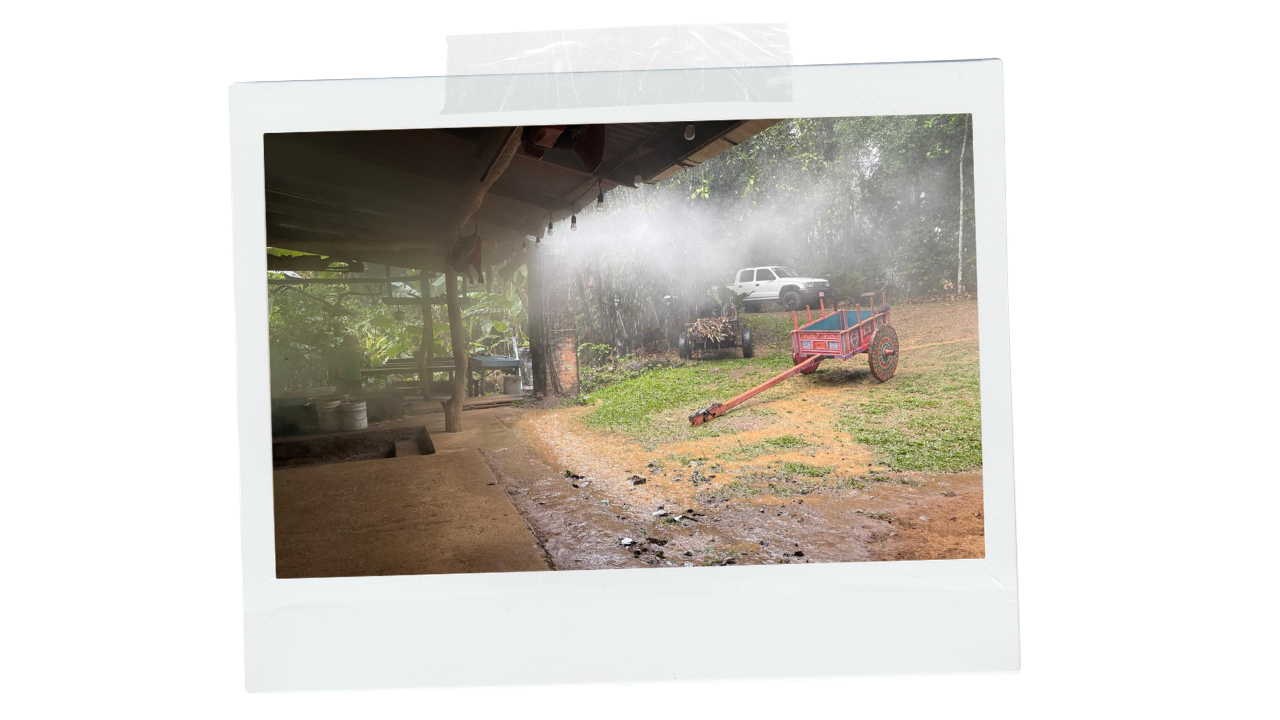 If the United States is a flannel button-down, Costa Rica is a solid pair of rubber rain boots.
As our nine months abroad come to a close, I have been reflecting on the ways I will attempt to convey my experience to friends and family back home. I have stories I can share, lessons I have learned, and cultural mannerisms I have adopted—some of which knowingly, and others likely unknowingly. Each of these can finely demonstrate moments from this program, but when I run through the details in my mind, there is still an ineffable element lost between the weeds.
For my friends and family back home, I have constructed this comparative parallel to capture what would be lost: an abstract, vibe-based correlation between the two cultures of outdoorsiness. I am choosing to speak to cultures of outdoorsiness simply because it is what I feel most qualified to examine—both due to my individual interests and internship placement at Centro Biológico Quebradas here in Pérez Zeledón.
Both articles of clothing serve specific purposes. They are similar in their sturdy and durable composition and are well equipped to withstand rugged environments. They also excel at retaining warmth and protecting our bodies from the natural elements. Though complementary, their form and function also diverge to fulfill different purposes. Beginning with form, the plaid flannel is colorful, made up of an extremely diverse selection of threads. I do not find the interwoven palettes gaudy, however, as I believe the colors of these threads contrast each other nicely, bringing out one another’s more subtle tones. The boots, on the other hand, are more uniform, though, for the sake of accurate representation, we’ll say that these particular boots have some colorful paint spills which pop against the background. Furthermore, the flannel is designed to be breathable as well as insulating, since it must be adaptable to colder and warmer climates. In contrast, our rubber boots are specially intended to insulate against water in muddy and wet terrain. Another obvious difference is that these items of apparel are designed for different parts of the body. Still, even aimed at protecting different vulnerabilities, their underlying objectives are the same, and they should possess no valid reason to compete with one another.
Of the many things I have learned this year, it has become abundantly apparent that an outfit is not complete with just one article of attire. It would be just as weird to leave the house in only a flannel shirt as it would be to do the same in a pair of rainboots. Equally, diversity among our cultures, and extensive knowledge and appreciation of them, offers a special breed of resilience and creativity when approaching new problems and innovation. If we put all of our resources into a single piece of clothing, we are not guaranteed some hyper-protective cloth that will ensure our survival. Instead, we will be left with a rigid cut of fabric that leaves one sleeve warm and the rest cold, and a warm arm serves little purpose if the remainder of the body’s blood flow freezes. Without a warm shirt, one will get cold when the winds stir. Without waterproof boots, one might get trenchfoot. Our commitment to a diverse collective empowers our interdependent survival during unpredictable weather, not to mention a complementary aesthetic beauty whose contrast gives meaning to light and depth to darkness, enlightening the summed experience of life on Earth.
Extending upon the metaphor of cultures to clothing, what if an individual possesses two shirts competing for the same torso? Which one is “better?” To appropriately answer, let us take a closer look at these shirts in question.
One of our subjects is the same flannel shirt from before. The other, not to be too direct with my implication, is a mandarin collar shirt. This second shirt is linen. It is still casual, but slightly more formal than the flannel from before. So, which should we choose to cover ourselves with?
Just as different articles within an outfit serve complementary but specialized purposes, I think most would agree that it is even more preferable to possess different outfits for different occasions. We do not live on a planet whose climate is perfectly homogenous, so why should we compete to opt for a singular style and function? A diverse collection of clothing is both aesthetically and practically advantageous to just one, offering a preparedness that is unequivocally beneficial not just to our survival, but our quality of life.
If we disregard our clothes and the value they provide, then we lie bare and naked against the cold apathy of their absence. In a world of increasing geopolitical tensions between cultures and nations, it becomes imperative to remember that these clothes we blindly tear from our bodies are the foundational fabrics that distinguish us from wild animals. When the rains begin to fall, it is of utmost importance that our clothing be secure, else we lose the things that cover our skin and keep us warm.
But alas, I digress. I had initially applied to this program because of my desire to explore the world and its cultures. I wished to leave the U.S. to take my time in life, gaining a more experiential set of knowledge before beginning college. I came to Costa Rica wearing a flannel button-down, and I will leave with a new pair of rubber boots. To my friends and family back home, there is no alternative to first-hand experience. A layer of ineffability lies within all emotion, and exposure to culture catalyzes its evocation. I am grateful to have had the opportunity to experience one more.
