 Log In


Bridge Year Costa Rica – Fall 2025
Selected Notes on Artistry
 October 29, 2025
I am stressed out about learning music to accompany recitals. I have the skillset. I just lack the discipline. I know I must develop it, but this still feels unreasonable. I am too anxious to sleep, thinking about it. Yes, it is low stakes, but for me, it is everything. I am brought back to the toxicity of my boarding school’s practice rooms. I hear my old teachers saying that this is the perfect opportunity to improve, but, truthfully, it is just too much for me to handle right now. I need to get out. I feel trapped. I love music, but I need a break.
November 07, 2025
I got what I wished for, I suppose. But it just doesn’t feel fair. After talking about the mental strain of working at the music school, I was removed from it without being asked what I wanted. I loved teaching my students. Even if they never practiced, it still brought me joy. I worry that the way I am bound to leave, will make it seem like I don’t care. I do not wish to abandon them so early into our student-teacher relationship, leaving them with nothing of real value. I never want to leave people like that. It hurts more than the work ever did.
November 11, 2025
Only days later, I was given the choice back—something I am deeply grateful for. Talking with an old classmate made me realize that artists always talk about quitting, even though they never do. An artist’s relationship with their craft is rather complicated. It is both a poison and its antidote. You cannot fathom living without it, albeit a constant demand for more than you have left to give. This contradiction is why an artist creates at all—to feel part of something greater, and to let others share in that sentiment. It is all too easy nowadays to just
give it up and never return. Maybe it would be simpler that way, but I don’t know if it would be better.
December 04, 2025
It has been nearly a month since I last wrote. I am sitting alone in a cafe as familiar American Christmas music buzzes through the radio. Just outside, the summer streets are alive—conversations in Spanish, cars with competing political messages blasting through loudspeakers haphazardly strapped to their roofs. I feel suspended in a strange state of limbo, reminded that the commercial aspects of Christmas follow you wherever you go.
My creativity feels out of balance. I don’t have the time to practice piano, and because of that, I feel disconnected from my artistry, watching my once-peers flourish in a high-stakes conservatory world I am no longer part of. I’ve ordered a small keyboard from the States, and it will arrive soon. I hope that with it, I can create again without the urgency of the creative community back home. There, art was made sacred. Now, I am responsible for making this new space sacred myself.
December 6, 2025
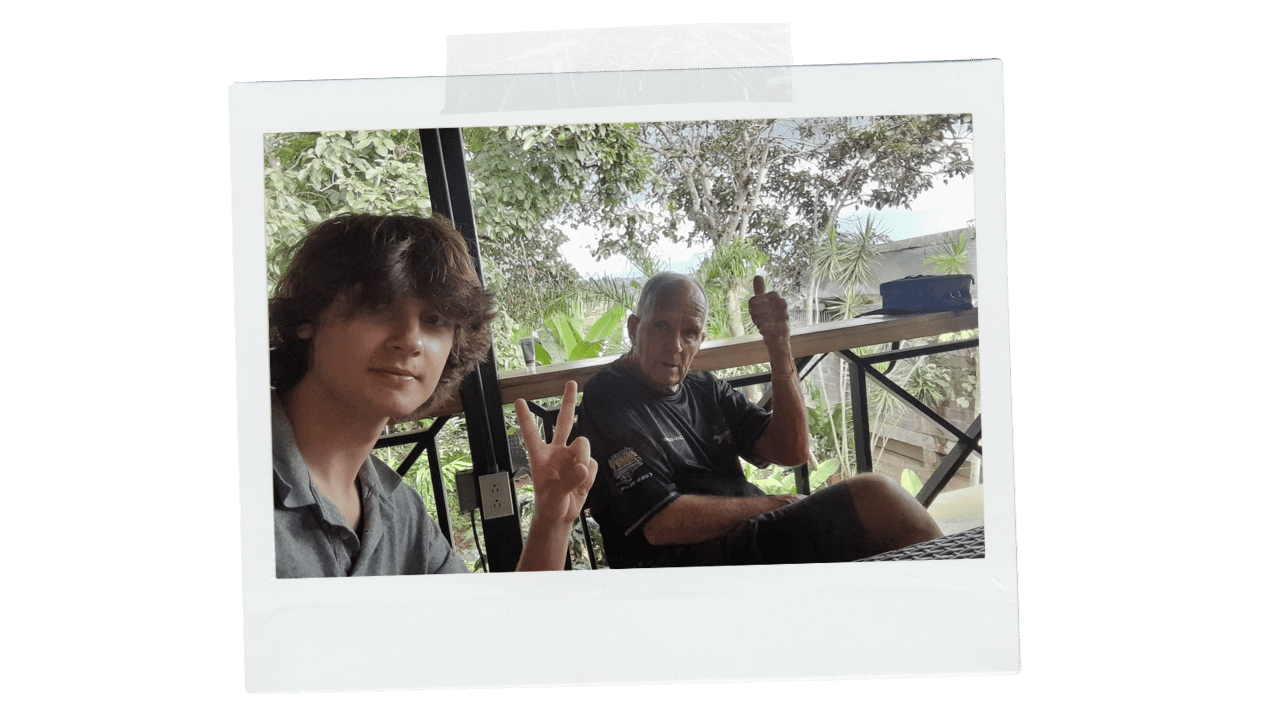
Through the usual tranquility of my job at Trincheras, a man enters through the storefront, greeting Natasha, my supervisor, in English—she cannot speak English, however. Eventually, after getting no reciprocation from his rather-political rant, he leaves. I joke to Natasha that it is probably best she didn’t understand what he was saying. She laughs and tells me that it is just Jimmy who is going to come back later.
He does come back, and this time he talks to me, asking where Alban (my other supervisor) is. He is here to get his computer fixed—a service not usually advertised by a bookstore, but one we are apparently happy to help with. I tell him Alban isn’t here today, but
I can take a look at it for him. It turns out he is just trying to sign in to iCloud to get some old photos before he moves to Fiji. He is 83 years old and lively as ever. He shares stories about growing up on a ranch in California with no one around him but his horses, how he became a stuntman in Hollywood, and long train rides from Los Angeles to New York City to star in a 60s sit-com. His wealth of stories are endless. Full of strange anecdotes of wisdom, yet they never connect or line up at any point whatsoever.
Once I get him signed in, he says he has to run to his car. I tell him I need to get back to work. He looks me in the eyes and says, “That’s the problem nowadays. Everyone has to work. You get to work.” The truth of it hits me harder than I expect. I take things for granted, even when I choose them myself. I am an artist not because I was forced into it, but because I chose it—and because I could never live without it. Jimmy returns with a large laminated map of Fiji. He points to a peninsula in the far north and tells me I could find him there if I ever needed to. “I’ll see you when I see you,” he says, and leaves. And right then and there, I had made my decision.
