What is AMIGOS Project Staff?
AMIGOS project staff are the young professionals who lead our programming in the countries where we operate. In 2026, we are operating open-enrollment projects in Panama, Costa Rica, Paraguay, and the Dominican Republic.
This is more than a job; it is a leadership experience that tests you both personally and professionally. It will make you grow in ways you did not even think possible. AMIGOS project staff roles prepare you for a future in any career field, equipped with soft and hard skills.
We hope that you accept the challenge to step out of your comfort zone and join the AMIGOS family.

Differences Between Roles
All of the roles on our project staff teams are critical to the success of the projects. Each role serves a specific purpose. See the Job Descriptions for more information.
The Project Director, Associate Project Director, and Project Supervisors all form part of the project staff team. They work closely together to facilitate an enriching program for the volunteers. Project Supervisors are not part of the senior staff team. All PST members are part of the broader AMIGOS summer teams. While members are assigned to a certain project, they may be moved to a different project at any point during the cycle. We look at our team holistically and arrange the teams in a way that all teams are set up for success.
The senior staff team is comprised of two roles: Project Director and Associate Project Director. These two team members work really closely together to lead the team of supervisors. They both arrive to the project site on the same day. See below for the differences in the roles.
The PD leads the show. They work closely with their direct supervisor (DS) to implement and evaluate a meaningful project for our youth participants and local partners. The PD manages the team, mentors fellow staff members, and provides general oversight of the project. They ensure day-to-day tasks are complete and that students and staff are safe and healthy. They also manage the use of funds and ensure ethical spending. They form part of senior staff.
The PD and APD will arrive on site the same day, one week in advance of project supervisor arrival. Together they will spend some in person time with their direct supervisor (DS) doing in person training and a handoff of the project information. They will then spend a few days traveling to the project areas to meet our partners in person and conduct host family visits and training.
Logistics: The PD start dates vary based on the project. Make sure to review the chart of dates for the projects. Prior to arrival in-country the PD will complete asynchronous training, live virtual trainings, meetings with DS, local partners, team members, and independent work time. See more in the training section for details. They arrive to the project site 12-28 days before volunteer arrival. From start to finish of the contract period all lodging, food, and transport for project purposes are covered by AMIGOS.
The APD is part of senior staff along with the PD. They share the responsibility of leading the team alongside the PD. On some projects, the APD will also directly mentor volunteers. This is a great entry role to serving on AMIGOS senior staff. The APD will be responsible for the overall budget reporting: ethically spending money and tracking funds, coordinating with partners and service providers, and facilitating activities.
Logistics: The APD will complete online training, both asynchronous and live sessions and attend a few meetings prior to arrival. Depending on the project modality, they will support with initial planning. They arrive to the project site 12-28 days before volunteer arrival. Their lodging and food are covered for the entirety of their contract period with AMIGOS.
This PSup position is focused on two main things: mentoring/supporting volunteers and facilitating program activities. They will assist with health and safety monitoring and will directly support volunteers. Their full focus is the volunteers and ensuring they have a safe and enjoyable learning experience. They also collaborate on project evaluation and ongoing paperwork. Depending on the project structure, they may support with some logistics, planning, and facilitating training activities.
Logistics: The Psups will complete online training. They arrive to the project 6-16 days before volunteer arrival. Their lodging and food are covered for the entirety of their contract period with AMIGOS.
Traditional Programs: On a traditional model program (DR 4-week and Paraguay 6-week), the psups will be spending 4 nights a week in rural communities with a host family and 3 nights a week in the staff house in the staff city. It is a role that requires a love of nature, hiking, and adventure since you will be traveling from one community to another every weekday. There may be more limited access to running water, electricity, and other amenities.
Group Travel Programs: On group travel programs, staff will be with the group at all times. They will be sleeping in the same lodging site as volunteers or staying with a host family. It is a role that requires a love of group activities, nature, and socializing.

All Staff Roles (PD, APD, Psup)
You are part of a team as a member of project staff. You have your individual project team, the country team, and the broader AMIGOS team. Everyone should be working towards the success of all projects. This means that you may need to take on new or different responsibilities at different points in the summer.
Some things all project staff should be prepared for:
Training
AMIGOS training is rooted in your leadership development. Through training you will learn the functions of your role, including leadership skills you will carry throughout your career.
Four key training areas: Leadership, cultural humility, ethical service, health and safety.
Training is tailored to your role, to ensure you have the information and training necessary to do your job well. It looks slightly different for each role.
Training will be online, asynchronous, and largely at your own pace with fixed deadlines for work products and quizzes. The course will launch on April 24th, 2026. Payment for training is dependent on completing modules on time and completing your assigned contract period.
If you are looking to be on project staff, clear your calendars! We have four mandatory and LIVE online sessions. PDs attend one additional training for a total of 5 trainings.
**Last week of May, PDs will have one additional 90-minute training.
All PST need to be First Aid and Emotional First Aid certified.
If you have valid and up-to-date certifications, submit them in the onboarding process.
AMIGOS will hold an Emotional First Aid Training on May 6th. If you cannot attend for any reason, you will be expected to receive the training elsewhere.
AMIGOS will provide a stipend to complete a Physical First Aid Training prior to arrival.
See below for the specifics for each role:
See below for the specifics for each role:
Exact training hours will be confirmed in the process of the acceptance of the role.
Standards of Conduct
The AMIGOS Standards of Conduct are an integral part of building and growing leadership skills. Their primary purpose is to help keep volunteers and project staff safe. The project staff’s adherence to the Standards of Conduct is the primary way that AMIGOS works towards ensuring their health and well-being during the program and positive interactions with partners. The Standards of Conduct come from many years of experience and recommendations.
Standards of Conduct
Staff members will NOT:
Professional Code of Conduct
At AMIGOS, we do our best to be professional, culturally appropriate, and respectful. As such, we follow a professional code of conduct and dress code for volunteers and Project Staff.
During your time as a staff member or as a volunteer, you are representing yourself, the values and mission of AMIGOS, our partner organizations, and your country. It is necessary to present yourself appropriately and professionally throughout your participation with AMIGOS. The way you present yourself is a crucial part of collaborating cross-culturally in local communities and with partner agencies, as such please follow the guidelines below that apply to all genders.
Consider the versatility of your clothing choices as packing space is limited. There is a specific packing list in the Project Information Packet (PIP). As a project staff member, you are a role model for the volunteers, you will not be allowed to wear clothing that does not meet the guidelines above.
Things You Should Know
Being a member of Project Staff is immensely rewarding and it is a challenging experience. It is important for you to take the following into consideration:
*Please note that non-U.S. citizens or non-U.S residents project staff may not be paid to a U.S. bank account.
Projects
All of our projects are unique, fun, and educational. Learn more about the specifics through our project pages.

Which Project Is Right for You?
All of our projects are unique, fun, educational, and interesting. We also want you to choose a project that feels right for you. First, check your date availability. We will not be approving exceptions, so check that you are available for the time frame of the position you are selecting. Next, take a look below to see some of the things project staff will be doing.
We have four overarching project structures. See a visual layout and more details here.
A couple additional things to keep in mind:
We want people that are interested in going to any project. While we understand you may have preferences, it is important to accept a role on project staff knowing that your role, country, and position are subject to change at any point during your contract. You need to be interested in being a part of the project leadership team more than where the role is in Latin America.
**More on Summer Programs here.

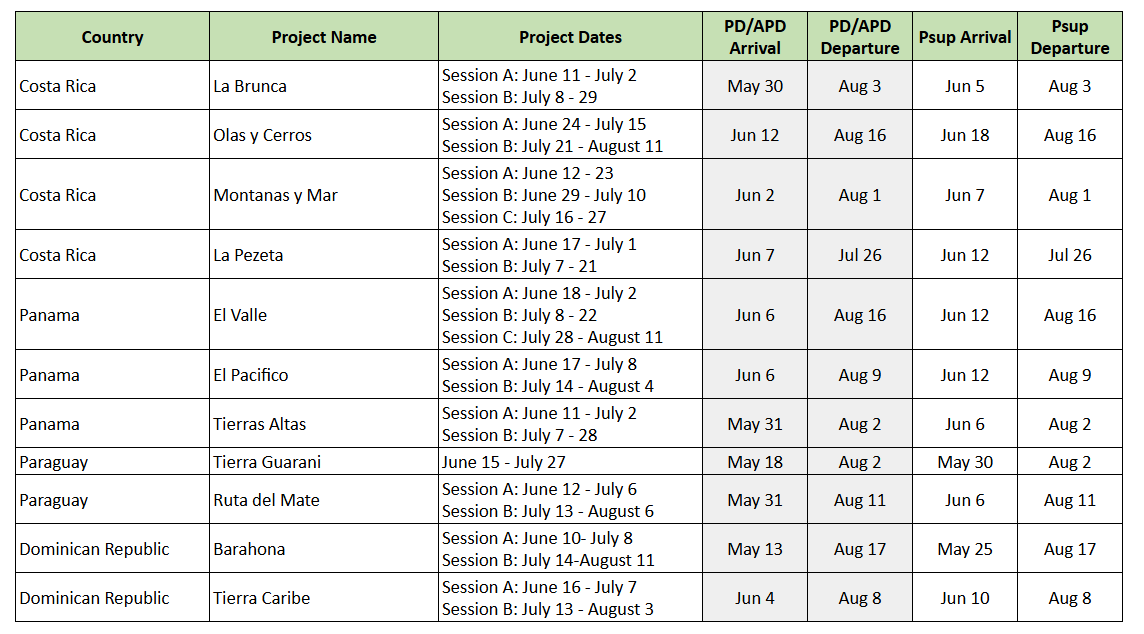
Project Staff Calendar by Project
Check to make sure you are available for the dates that you need to be on site for each project. Only apply to projects for which you have full availability.
*Dates are subject to slight change. Please bear in mind that your travel date may change. For example, there may be circumstances in which you may arrive to country one day earlier or later than is stated on your offer letter. Make sure you are available one day before and one day after the dates listed in the chart for the projects you select.
Benefits and Why to Join Project Staff
If you want to make a lot of money this summer, this is not the job for you. However, serving on AMIGOS project staff provides skill-building and professional development opportunities that are unparalleled in addition to some perks!
Soft skills are non-technical skills that relate to how you work. They include how you interact with colleagues, how you solve problems, and how you manage your work. (1) These are not only job skills but life skills that will help you succeed both personally and professionally.
Hard skills are objective, quantifiable skills gained through training, school, or work experiences. Hard skills are often usually something that can be taught or learned.
While being on project staff may not be your typical job, it will provide you with lifelong skills, an amazing community of people, and the chance to visit new places.
*Exceptions apply.
(1) https://www.thebalancemoney.com/what-are-soft-skills-2060852
Hiring Timeline
We are hiring on a rolling basis this year. All dates are tentative and subject to slightly change.
We encourage you to apply as soon as possible for first choice of spots.
All positions are posted on our website! Click here.
The earlier you apply the better—spots will fill up! We are hiring for all roles. The early you apply to be a Project Supervisor, the more likely you will get a role.
Meet Former Project Staff Members – PST Testimonials
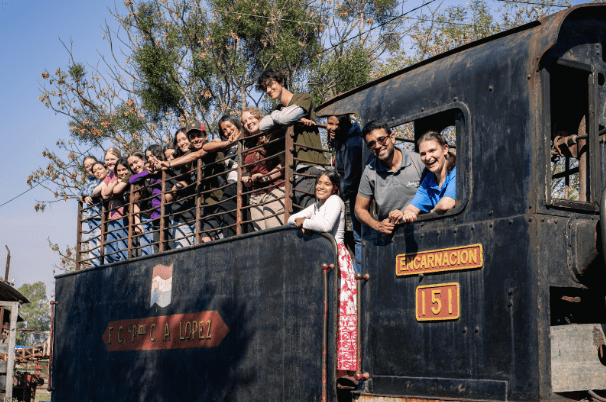 Junyor Florentin (Youth Ambassadors, Project Director in Paraguay, Tierra Guarani)
I first joined AMIGOS as a Youth Ambassador in 2018. That transformative experience led me, a year later, to complete an internship with that same program, where I supported the logistics and coordination of an exchange for 18 adolescents from the United States in Paraguay. Thanks to those two experiences I truly understood the power of intercultural connections and the importance of supporting youth through meaningful experiences. Still, nothing compares to what I lived in 2025 as Project Director of the Tierra Guaraní Immerse Program in Paraguay.
This year, I led a team of three and worked with them in seven rural communities in the department of Guairá, where 18 US teenagers lived for 6 weeks with host families and collaborated with local youth leaders to carry out community projects in schools, chapels, and other public spaces. Together, they built fences, created school gardens, and made improvements to children’s dining halls, impacting more than 250 families. Seeing volunteers and communities take ownership of these projects strengthened my belief in a development model rooted in active participation and genuine cultural exchange.
As project director, I applied and strengthened essential skills: teamwork, building and sustaining relationships with partner agencies, managing health and safety for volunteers and staff, administering the program budget, documenting and monitoring activities, and facilitating training workshops for both my team and the volunteers. Each of these responsibilities was key to supporting a project that required cultural sensitivity, organization, and human-centered leadership.
Being part of AMIGOS again was deeply meaningful. It reaffirmed that this is the kind of work I want to continue doing. That’s why I hope to return as a Project Director next year and keep building experiences that transform lives, including my own.
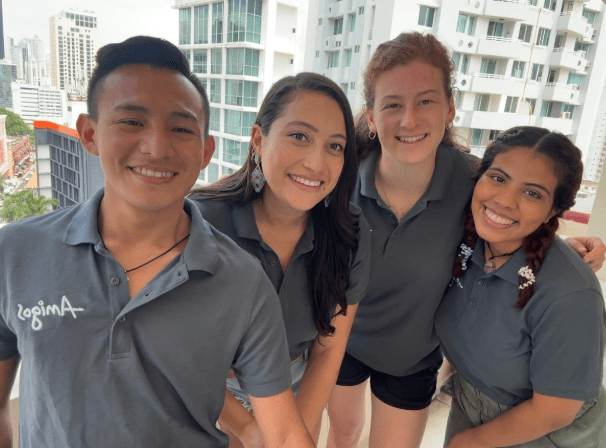 Abigail Krenz, Ecuador ‘21, Panama ‘23, Panama ‘25
Abigail first fell in love with AMIGOS in high school while volunteering in Ecuador. As she stayed on an organic farm, she milked cows, mixed organic compost, and prepared traditional Incan foods. Along the way, she learned about sustainable agriculture and indigenous food sovereignty—more than she ever could have in just a classroom. With the support of Ecuadorian volunteers and community members, she grew more confident in her Spanish and eventually formed lasting friendships across a language barrier.
After her first year of college, she was eager to return to AMIGOS. Working as a project supervisor in Tierras Altas, Panamá, she supervised 12 volunteers and collaborated with four local partner agencies in a project focused on sustainable agriculture and environmental protection. In collaboration with community leaders, Abigail supported volunteers as they tilled organic soils, planted trees, and cared for orchid plants. To supplement this hands-on learning, she developed bilingual workshops on identity, culture, and history across the US and Panamanian contexts, allowing volunteers to learn from fellow volunteers and their host community while reflecting on their own roles as leaders.
Drawn back to the beautiful mountains and welcoming community of Tierras Altas, she returned to AMIGOS in 2025 as a project director. In this role, she oversaw the expansion of the project to include the participation of local youth leaders, partnerships with three local schools, and nearly 40 hours of programming for kids in the community. It was an honor to collaborate with and learn from her amazing staff team, host families, and partner agencies to build meaningful and supportive programs.
Through AMIGOS, Abigail has learned how to communicate confidently in Spanish, support a team through challenges big and small, and collaborate closely with community partners to design, implement, and evaluate projects aligned with local priorities. She highly recommends AMIGOS to anyone interested in growing as a leader and learning alongside extraordinary people.
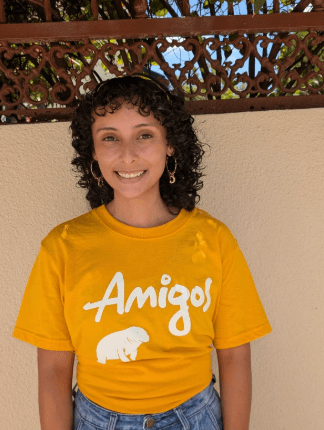 Ali Castro – Costa Rica ‘24, Dominican Republic ‘25
As a supervisor in Costa Rica, through the La Pezeta program, I had the opportunity to share not only the culture and traditions of my country, but also an important part of who I am. Teaching volunteers the way we Costa Ricans speak, our everyday expressions, and the warmth that identifies us as “ticos” was truly enriching. One of the moments I enjoyed the most was sharing my passion for Costa Rican folkloric dance. Seeing the volunteers interested in learning about our dances and their cultural meaning made me feel even more connected to my roots. Spending one-on-one time with them allowed me to better understand their motivations, listen to their stories, and build meaningful connections. At the same time, those conversations helped me learn more about myself and strengthen my leadership skills.
My experience in the Dominican Republic, through the Cultural Connection Through Sports Barahona program, was completely different but just as valuable. Connecting with a new culture, full of vibrant traditions and unique energy, was wonderful. I learned so much from working with the communities and observing how sports can become a powerful bridge that brings people together. Listening to the volunteers’ stories—their challenges, their accomplishments, and the relationships they built within their assigned communities—was inspiring. Each experience they shared highlighted the positive impact that cultural exchange can have on both individuals and communities.
Both programs shaped my personal and professional growth. Thanks to these opportunities, I now appreciate even more the importance of empathy, culture, and community engagement as tools to create meaningful change.
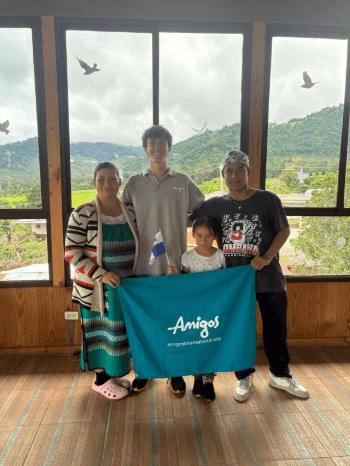 Jake Luria, Panama ‘25
My summer with AMIGOS in the Tierras Altas of Chiriquí, Panama was one of the most meaningful and formative experiences of my life. I lived in the rural town of Guadalupe, surrounded by mountains, farms, and the warmth of a community that immediately treated me like one of their own. My host family, two incredible parents and their two kids, welcomed me into their home with a kindness I will never forget. They taught me recipes, helped me practice Spanish every day, and made the house feel like a home from the very first week.
As a Project Supervisor, I worked volunteers in this same region. Supporting them through their community partnerships, daily challenges, and cultural immersion taught me so much about leadership, communication, and patience. I learned how to guide young people through unfamiliar environments, how to help them build confidence in their Spanish, and how to empower them to take ownership of their experience.
Our community work focused heavily on sustainability in the rural highlands. We partnered closely with local leaders. Together, we worked on composting, community beautification projects such as planting flowers and restoring the town’s welcome sign, painting classrooms and school walls, helping host families in their gardens, and teaching environmental lessons to local youth. One of my favorite parts of the summer was helping both my volunteers and the local students realize that sustainability isn’t abstract something anyone can practice in small, daily ways.
The work was rewarding, but what stayed with me even more deeply were the everyday interactions: long conversations with neighbors, laughing with my host siblings, walking through town and recognizing familiar faces, and watching volunteers grow more confident and independent each week. The people in Tierras Altas were some of the most welcoming I’ve ever met, and their generosity is something I still carry with me.
My time in Panama strengthened my Spanish, expanded my understanding of community-driven development, and showed me the beauty of rural Panamanian culture. More than anything, it reminded me how powerful it is when people come together—across cultures, ages, and backgrounds—to learn from one another and build something meaningful.
Testimonials
This summer was definitely challenging but also super rewarding. I think I grew a lot both professionally and personally, and while it was difficult at times, I am really happy that I got to have this experience.
This summer has been one of the biggest learning experiences I’ve had in my life. It was amazing to implement such a great program. The experience was both challenging and fulfilling and taught me about the life and professional skills I had and [those that] I gained.
Fué una gran experiencia para mí, llena de aventuras y aprendizajes. En general lo describo como un proceso de crecimiento y desarrollo profesional, en el cual pude aprender muchísimo de varios campos, sentirme mas confiado y seguro personalmente.
Fulfilling. The work was hard but wonderful.
My experience working with AMIGOS was a once-in-a-lifetime opportunity for growth.
It was an amazing but challenging experience. It definitely pushed me out of all my comfort zones, but I feel great of being able to achieved many goals. I learned a lot from others and from myself. Life changing!
Fue una experiencia increíble que sumó mucho en mi vida personal, y espero poder ser parte de Amigos en algún otro proyecto o de alguna manera. Es super retadora y llena de dificultades, pero hay mucho soporte detrás y eso hace que todo sea más fácil.
AMIGOS taught me a lot about myself, my perception, and my leadership. It opened me to a new country, where I had to look inward for comfort and outward to my team for support. It exposed me to young leaders who had differences in perspective, opinions, and experience. It taught me what it really meant to be a mentor.
AMIGOS has helped me to feel more confident in my ability to connect with others and work in various challenging settings. I was pushed outside of my comfort zone with the work that I needed to do, as I wasn’t used to being responsible for so much paperwork and logistics. But I learned valuable skills and how to stay organized, which involves journaling out my responsibilities. I have also realized how much I love living in another culture and experiencing another way of life, and I hope to continue to do so in the future.
Aprendí muchísimo de mí mismo, y de las habilidades que tengo para resolver problemas. Me di cuenta de mi potencial y de lo que soy capaz de hacer.
AMIGOS has made me a better communicator, decision-maker, and teammate. AMIGOS has taught me that I can do anything I set my mind to and that I am capable of taking on huge responsibilities. It has also taught me that if you believe in others, the capacity in the others is pretty huge too!
Living this experience changed me in many aspects and ways, at personal and professional levels. At a personal level, it was challenging and touching for me to see myself in this role. When I was a participant of AMIGOS YA Program, I dreamt a lot about being a staff member, and now that we are finished, I am proud of having had a successful experience on the role. Also on the professional level, it made me realize that I enjoy doing this kind of job, so now I feel more focused on what I want to do in the near future.
En gran área, siento que Amigos me hizo crecer muchísimo, mas de lo que pensaba. Me hizo tener otra perspectiva, otra mentalidad. Pude aumentar mi confianza y seguridad en el momento de realizar distintas cosas.
Through my experience with AMIGOS, the biggest thing I gained is the unwavering belief that I am ready for anything now. The immersive cultural exposure, the challenges I faced while living in a different community, and the opportunities to develop leadership and communication skills have all contributed to this newfound confidence. AMIGOS has instilled in me the ability to adapt, connect, and engage with diverse situations and people, empowering me to approach any future endeavor with a sense of readiness and capability.
I think AMIGOS serves as my most professional title at this point in my post-college career. I will draw on my experience across a wide variety of skills (interpersonal skills, budgeting skills, Spanish skills, youth mentorship and education skills, time management skills) and responsibilities (making decisions about budget, being in charge of myself and others’ health and safety, holding ourselves accountable to standards of conduct and AMIGOS protocol). I think almost anywhere I apply for work I can reference this experience in some way that will add to my application.
 Log In